


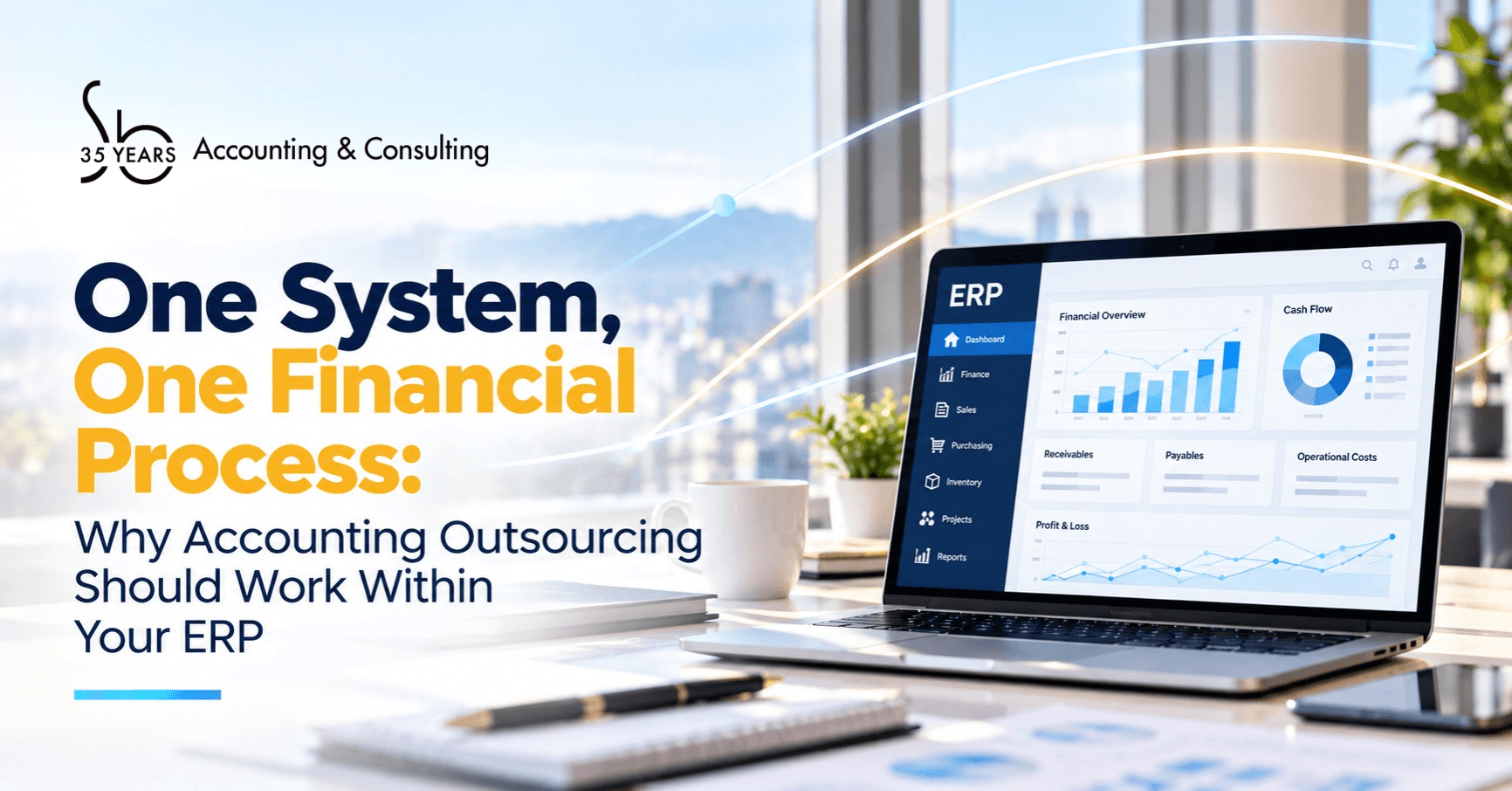
One system, one financial process? How companies can combine the expertise of an external accounting provider with the control, visibility, and efficiency of their existing business software.
The Hidden Cost of Running Two Accounting Systems
Imagine a company that has invested significant time and resources in implementing an Enterprise Resource Planning (ERP) system. Its sales, purchasing, inventory, and financial teams work within the same platform. Transactions are recorded, documents are approved, and management reports are generated from a central database.
Yet, at the end of each month, the company must export its financial information and send it to an external accounting provider, who processes the same data in a completely different system.
The accounting team then prepares reports that may need to be reconciled with the information already available in the company’s ERP.
This situation is more common than many businesses realise.
Traditional accounting outsourcing often assumes that the service provider will use its own accounting software. While this approach may be suitable for smaller businesses without established financial systems, it can create unnecessary complexity for companies that already operate sophisticated ERP platforms.
The result is often a fragmented financial process involving duplicate data entry, additional reconciliations, separate reporting environments, and increased administrative work.
But what if outsourcing accounting services did not require outsourcing the accounting system itself?
An alternative approach is gaining relevance: providing complete accounting services directly within the client’s existing ERP or accounting software.
This model allows businesses to retain their established technology while benefiting from external accounting expertise.
Why Should One Company Maintain Two Financial Systems?
When an external accounting provider operates in a separate system, financial information must move between two environments.
This typically involves exporting invoices, transaction records, payment information, and supporting documents from the client’s ERP and importing them into the provider’s accounting platform.
Depending on the systems involved, this process may require manual intervention, customised integrations, or regular reconciliation.
Each additional step introduces potential inefficiencies.
For example, a sales invoice may already exist in the client’s ERP, complete with customer details, applicable taxes, and internal approval information. If the accounting provider needs to recreate or import that invoice into another system, the company effectively introduces a second administrative process for the same transaction.
Even when data transfers are automated, someone must maintain the integration, monitor errors, and investigate discrepancies.
Working directly within the client’s system can eliminate or significantly reduce these duplicated activities.
The objective is simple: financial information should be recorded and processed in the most efficient way possible, without unnecessary movement between platforms.
This does not mean that every integration becomes unnecessary. Some businesses will still require connections with banks, payroll applications, document management platforms, or other specialised solutions.
However, removing the need for a separate accounting ledger can simplify the overall financial architecture considerably.
A Single Source of Financial Information – One System, One Financial Process
One of the greatest advantages of accounting within the client’s ERP is the ability to maintain a consistent source of financial information.
In a traditional outsourcing arrangement, management may rely on reports from its ERP while the external accounting provider maintains another set of records.
Differences can arise because of timing, accounting adjustments, incomplete data transfers, or inconsistent classifications.
Consequently, finance teams may spend valuable time determining which figures are correct.
When both parties work within the same accounting environment, these discrepancies can be reduced.
The external accounting team records transactions, performs reconciliations, and prepares financial information directly in the system used by the business.
Management can access the same underlying records, subject to the company’s reporting configuration and access permissions.
This creates a more transparent relationship between operational activity and financial reporting.
For financial directors, the benefit is particularly important.
Instead of waiting for information to be transferred between systems, they can potentially obtain a more current view of the company’s financial position.
A shared system also makes it easier to investigate individual transactions, understand accounting adjustments, and trace financial information back to supporting documents.
One accounting environment means fewer competing versions of financial reality.
Less Administration, More Valuable Financial Work
Accounting departments often spend considerable time on activities that do not directly create business value.
These include transferring information, correcting import errors, matching records between systems, and investigating differences caused by inconsistent data.
Although necessary in certain operating models, such activities rarely improve the quality of financial decision-making.
When accounting services are delivered within the client’s ERP, a portion of this administrative workload can be reduced.
For example, approved supplier invoices may already be available in the system with the necessary supporting documentation. The external accounting team can review and process these transactions without requiring a separate exchange of files.
Similarly, bank transactions, customer invoices, and other financial records may be accessible through existing workflows.
This can improve efficiency during monthly closing, particularly when responsibilities and approval procedures have been clearly established.
The potential benefit extends beyond processing speed.
Time previously spent on repetitive administrative activities can be redirected towards reconciliations, financial controls, reporting quality, and identifying issues that require management attention.
For companies evaluating outsourcing providers, this distinction matters.
The objective should not simply be to find someone who can process transactions at a competitive price.
It should be to establish a financial process that uses resources effectively and delivers reliable information.
Outsourcing Without Losing Control If Not as One System, One Financial Process
One concern frequently raised by companies considering accounting outsourcing is the potential loss of control over their financial information.
When the external provider uses a separate accounting platform, the client may depend on that provider for access to certain records, reports, or historical information.
This dependency can become particularly problematic when management requires immediate financial data or when the company decides to change service providers.
Accounting within the client’s ERP offers a different arrangement.
The company retains its existing financial system, while the external accounting provider receives the access necessary to perform agreed services.
The business can maintain ownership and administrative control of its system and data, subject to its contractual arrangements with the software vendor and service provider.
This creates opportunities for a clearer division of responsibilities.
For example, the client’s employees may remain responsible for creating and approving commercial documents, while the external accounting team performs accounting checks, reconciliations, statutory reporting, and other agreed activities.
Access permissions can be configured according to individual roles.
Sensitive actions may require additional approvals, while system logs can help track changes and user activity.
These controls depend on the functionality of the ERP and the way it is configured.
Nevertheless, the underlying principle is important: Outsourcing a financial function should not automatically mean surrendering control over the systems and information supporting that function.
Connecting Accounting with Business Operations
Accounting does not exist independently of the rest of a company.
Every sales transaction, purchase, inventory movement, project expense, and payroll calculation eventually affects financial reporting.
Modern ERP systems are designed to connect many of these activities within a shared business environment.
When accounting is performed directly within that environment, the external accounting provider can work more closely with the company’s operational processes.
Consider a business that manages purchasing and inventory through its ERP.
Supplier invoices may already be connected to purchase orders, goods receipts, and approval workflows.
If accounting takes place in the same system, the accounting team can potentially use these relationships to verify transactions and identify inconsistencies.
A similar principle applies to companies managing multiple projects, departments, or cost centres.
Financial information can be recorded according to the reporting structures already established by management.
This may improve the consistency of internal and statutory reporting, provided that the ERP supports the relevant accounting requirements.
The result is a more connected approach to financial management.
Rather than receiving accounting information as a separate output after operational activities have taken place, businesses can integrate accounting into their established workflows.
This can support better collaboration between finance, operations, procurement, and management.
Different Approach to the Cost of Outsourcing
Companies frequently compare accounting outsourcing providers primarily on their monthly service fees.
However, the true cost of an accounting process is broader than the invoice issued by the external accountant.
It may include software licences, integration development, internal administrative time, data reconciliation, system maintenance, and the cost of correcting errors.
For a company operating two financial systems, these additional expenses can be substantial.
Using an existing ERP for outsourced accounting may reduce certain costs, particularly those associated with duplicated processes and data transfers.
At the same time, the model is not automatically cheaper in every situation.
The client’s ERP may require additional licences, configuration, training, or specialised accounting knowledge.
Some systems may also need adjustments to support local statutory and tax requirements.
Therefore, the correct comparison is not simply between two monthly accounting fees.
It is between the total cost of operating the financial process under different service models.
A slightly higher accounting service fee may still represent better overall value if it eliminates significant administrative work or reduces the need for separate integrations.
The most appropriate solution depends on the company’s size, transaction volumes, existing technology, and internal capabilities.
Security, Accountability, and Business Continuity
Allowing an external provider to work within a company’s ERP requires a structured approach to security and governance.
Access should be granted according to the principle of least privilege: users receive only the permissions necessary to perform their responsibilities.
Where possible, companies should use individual accounts, multifactor authentication, approval workflows, and audit trails.
Responsibilities must also be clearly defined.
Who creates supplier records? Who approves invoices? Who posts accounting adjustments? Who reviews reconciliations? Who authorises changes to the chart of accounts?
These questions should be answered before the service begins.
A successful outsourcing arrangement should also include documented procedures, escalation channels, service expectations, and continuity arrangements.
This is especially important because financial operations cannot depend exclusively on one individual.
A well-organised external accounting team should be able to maintain service continuity through established processes, appropriate documentation, and internal quality controls.
Technology supports this structure, but it does not replace professional accountability.
The value of outsourcing comes from combining reliable systems with competent specialists and clearly managed responsibilities.
What If Your ERP Is Not Fully Localised for Bulgaria?
One of the main reasons international companies maintain two accounting systems is the assumption that their existing ERP cannot fully support Bulgarian statutory and tax reporting requirements.
Many businesses use international platforms such as SAP, Oracle NetSuite, or Microsoft Dynamics, which may not include all the functionality required for Bulgarian VAT reporting, Intrastat declarations, SAF-T, and other local regulatory obligations.
As a result, companies often maintain a second accounting system in Bulgaria, creating duplicate entries, additional reconciliations, and unnecessary administrative costs.
However, the absence of full Bulgarian localisation does not necessarily mean that a second accounting system is required.
At Sb Accounting & Consulting, we can help companies address these challenges while keeping their existing ERP as the primary accounting environment.
For example:
- VAT reporting: Even if the ERP cannot automatically generate Bulgarian VAT ledgers and returns, the necessary transaction data can often be extracted, validated, and processed through supplementary reporting tools.
- Intrastat: Information already available in the ERP, such as commodity codes, transaction values, quantities, and countries, can be used to prepare the required declarations.
- SAF-T: Where the ERP does not support the Bulgarian SAF-T format, accounting data can be mapped, structured, and transformed through appropriate technical solutions to meet applicable reporting requirements.
- Other statutory obligations: Local financial statements and regulatory reports can often be prepared using structured exports, reporting tools, and the expertise of Bulgarian accounting specialists.
Our approach starts with an assessment of the client’s ERP, available financial data, and local compliance requirements. We then identify which obligations can be managed directly within the system and which require supplementary reporting processes or technical adjustments.
For example, a company using NetSuite for its international operations may not need to maintain a separate Bulgarian accounting ledger simply because NetSuite lacks certain local reporting functionalities.
Instead, the primary accounting records can remain in NetSuite, while Bulgarian statutory and tax reporting is handled through complementary solutions.
Naturally, this model depends on the ERP’s capabilities, data quality, and the applicable regulatory requirements. Each implementation requires an individual assessment.
The key message is simple: your ERP does not necessarily need to be fully localised for Bulgaria for us to provide accounting services directly within it.
By combining international ERP systems with local accounting expertise and appropriate reporting solutions, businesses can reduce duplicated work, simplify financial processes, and maintain compliance without automatically introducing a second accounting environment. We believe in one system, one financial process.
Your ERP, External Accounting Expertise
At Sb Accounting & Consulting, we believe that accounting outsourcing should be designed around the operational needs of the client, rather than automatically requiring the client to adopt a separate accounting environment.
Where the client’s software and the applicable regulatory requirements allow, delivering accounting services within the existing system can offer a more integrated approach.
The company retains its established financial environment, while an external team contributes accounting expertise, process discipline, and support with statutory obligations.
This approach can be particularly relevant for international businesses, companies with established ERP systems, and organisations seeking to combine internal financial control with outsourced professional services.
Successful implementation requires close cooperation between the client’s finance and IT teams and the external accounting provider.
It also requires a clear understanding of what each party is responsible for and how the quality of financial information will be maintained.
The ultimate objective is not simply to reduce the number of software applications.
It is to create a more efficient, transparent, and reliable financial process.
One System, One Financial Process, Better Collaboration
The traditional distinction between internal accounting systems and external accounting services is becoming less relevant for companies that already operate integrated business platforms.
Outsourcing does not necessarily require a second accounting environment.
With the right technology, processes, and professional expertise, companies can benefit from external accounting services while continuing to work within their existing ERP.
The potential advantages are clear: less duplication, improved visibility, stronger collaboration, and more efficient use of resources.
However, these benefits depend on careful implementation, appropriate controls, and the suitability of the software.
The future of accounting outsourcing is not simply about who processes the transactions. It is about how effectively accounting expertise, technology, and business operations work together.
For companies that have already invested in their ERP infrastructure, the next step may not be another system.
It may be finding the right accounting partner to work within the one they already have – one system, one financial process.