




Fill in your declaration for Tax relief for children or children with disabilities quickly and easily, in just a few clicks. Use the form from the link below, completely free and available to everyone.
To fill in the tax-relief declaration follow these 4 steps:
- Go to tax.sb-bg.com
- Fill in the form
- Download the generated declaration or send it to your e-mail
- Sign the declaration and send it to your HR specialist


Frequently asked questions
Тhe tool is free and accessible for all persons who wish to optimize the completion of the declaration, in order to exercise their right to tax relief.
Sb customers will receive the collected data in order to optimize the administration of the tax relief, and companies that are not Sb clients may contact us to specify the method of transmission of the collected data for their employees.
No, you do not lose the right. You simply won’t be able to use your employer as an intermediary. You can still take advantage of the tax relief by independently submitting an annual tax return by April 30 of the following year and attaching the corresponding tax relief declaration (under Article 22v and/or Article 22g of the Personal Income Tax Act).
If an individual has an unserved traffic ticket issued by the Traffic Police (KAT) which is currently unavailable for payment, this circumstance per se shall not preclude the utilization of the child tax relief, provided that at the time of claiming the tax relief, the individual has no outstanding public liabilities subject to compulsory enforcement.
In the event that the traffic ticket is served within the period from November 30 to December 31, the individual may utilize the tax relief through her/his employer, subject to the condition that at the time of utilizing the relief, the ticket has not entered into force as an enforceable public liability, or that the respective obligation has been extinguished.
Should the tax credit not be utilized through an employer, the individual is entitled to claim it via the annual tax return by April 30 of the following calendar year, enclosing the relevant declaration for the utilization of tax relief for children and/or children with disabilities, in compliance with the statutory requirements.
If you do not wish to wait for the traffic ticket to be served, you can go to the respective regional office of the traffic police (KAT) and receive the traffic ticket in person.
If an individual wishes to take advantage of submitting a tax relief declaration for children and/or children with disabilities through his/her employer, the deadline for paying all public liabilities is the moment the corresponding declaration (under Article 22v and/or Article 22g of the Personal Income Tax Act) is submitted to the employer, which can be done at any time between November 30 and December 31.
If the individual claims the tax relief independently through his/her annual tax return, public liabilities must be cleared by the time of its submission (the final deadline for this is April 30 of the following year).
Yes, it is correct that in order to take advantage of the measure, the parent must have no public liabilities subject to enforcement. The individual can check whether his/her has any liabilities by reviewing his/her tax and social security account with the NRA or at the relevant municipality. The employer is not required to verify this; the employer relies on the employee’s statement in the declaration under Article 22v or Article 22g of the Personal Income Tax Act.
Exactly/Precisely. The requirement to settle public liabilities includes obligations for local taxes, fees, and fines.
Since the law does not impose a penalty if an employer refuses to accept the declaration for tax relief for children or children with disabilities, it is possible that such a situation could occur without specific adverse consequences for the employer. However, the employer’s refusal does not deprive the individual of their right to claim the relief – they can still do so by submitting their annual tax return.
In the case of the other parent passing away or if the other parent is not known, it isn’t necessary to fill out the details about the other parent in the declaration (Article 22v or Article 22g of the Personal Income Tax Act) if they are unknown or have passed away.
When the declaration under Article 22v or Article 22g of the Personal Income Tax Act is submitted through the employer, public liabilities must be settled by the date the declaration is submitted to the employer. The deadline for submitting the declaration through the employer is between November 30 and December 31.
When the declaration under Article 22v or Article 22g of the Personal Income Tax Act is submitted personally by the parent with the annual tax return (ATR), the liabilities must be settled by the date the ATR is submitted, but no later than April 30.
When the parent claiming the relief is a Bulgarian citizen, there is no need to attach a birth certificate. The child’s Personal Identification Number (PIN) is filled out directly in the declaration under Article 22v/Article 22g of the Personal Income Tax Act.
When the parent is a foreign individual, the child’s birth certificate should be attached to the declaration. Individuals from the European Union can use the European birth certificate form, which does not require an official translation or an apostille.
Due to the specifics of the process for calculating compensation, we will not be able to notify our clients in advance whether a given person has the necessary taxable income to take advantage of the tax relief. However, when the calculations are presented for approval, this information will be available, and there will be time to discuss it with employees and potentially make any necessary changes.
If the employer has implemented the Sb system for electronic employee files, the electronically collected declarations will be uploaded to the employee’s file and will be sent to the employee for signing.
Yes, the employees will have to print out the declarations they receive by email, sign them, and hand them over to their employer.
If the employees are tax residents of an EU member state or of a country that is a party to the European Economic Area (EEA) agreement, they can benefit from the relief, provided they also meet the other legal criteria.
For this particular employee, her/his income for the entire year is considered. It should be noted that for the period before September, she/he need to provide a certificate from her/his previous employer under Article 45 of the Personal Income Tax Act to determine the tax base for the entire year. If the employee has never worked before and has no previous employer, only the income from September to the end of the year will be considered.
The employee fills out two declarations. One under Article 22v, paragraph 8 of the Personal Income Tax Act for the three children, and another under Article 22g, paragraph 7 of the Personal Income Tax Act for the child with a disability.
You need to add up the tax bases from all your payslips for the entire year. Each payslip has a line showing the tax base for that month.
The employee has the right to claim tax relief for children through their employer, even if they will be filing an annual tax declaration. In the annual tax declaration, they will simply need to indicate the number of their children in the appropriate section.
If the employee leaves before or during December, she/he may claim their tax relief through their next employer only if the employee has an employment contract with the new employer as of December 31, which constitutes a primary employment relationship. It is done by providing a certificate under Article 45 of the Personal Income Tax Act from their previous employer.
If the employee will not have a new employer, she/he will need to submit an annual tax declaration.
Yes, you can benefit from tax relief through your employer and file an annual declaration after that.
It’s better if the other parent submits a declaration to his employer because he has a higher annual taxable income.
You should file your declaration to your last (current) employer.
Option 1: The other parent can claim this tax relief.
Option 2: The employee can submit an annual tax return.
The employee must sum up all the taxable incomes from her/his payslips until now.
Self-employed individuals can also benefit from tax relief for children through their annual tax return, regardless of whether they have provided personal labor.
Only the annual taxable income from the current employer will be used.
However, if the employee knows she/her will receive the certificate later, it is better to submit an annual tax return directly. This way, the employee can use the total annual taxable income from all employers. Otherwise, the employee risks not to be able to fully utilize the tax relief with his current employer, and the other parent may need to submit an annual tax return.
If you take advantage of the tax relief for children (and children with disabilities), the amounts that will be deducted from the annual tax base of the employee are for 1 child – 3067,75 EUR, for 2 children – 6135,50 EUR, for 3 or more minors – 9203,25 EUR, for 1 child with ≥ 50% disabilities – 6135,50 EUR.
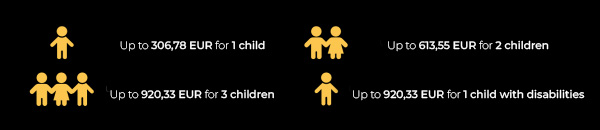
Net amount granted to each employee is as follows:
- up to 306,78 EUR for 1 child
- up to 613,55 EUR for 2 children
- up to 920,33 EUR for 3 children
- up to 920,33 EUR for 1 child with disabilities (the ammount for 1 child is included)
The amount of tax relief depends on the number of children and the amount of the parent’s tax base.
Yes, the tax relief for children and children with disabilities could be received in advance.
For income from employment relationships, the monthly tax base for the relevant month is reduced by the following amounts:
- for one minor child – up to 255,65 EUR per month
- for two minor children – up to 511,19 EUR per month
- for three or more minor children – up to 766,94 EUR per month
- for a child with 50 and over 50% type and degree of disability – up to 511,29 EUR per month
For this purpose, the employee once chooses to apply the advance use of tax relief for children and/or for children with disabilities by providing a written declaration to the employer.
Тhe tool is free and accessible for all persons who wish to optimize the completion of the declaration, with which to exercise their right to tax relief.
Sb customers will receive the collected data in order to optimize the administration of the tax relief, and companies that are not Sb clients may contact us to specify the method of transmission of the collected data for their employees.
Parents of children with disabilities have the right to benefit from the “Tax Relief for Children”. To do so, you should fill in and provide your employer with a total of two declarations – “Tax Relief for Children” (306,78 EUR) and “Tax Relief for Children with Disabilities” (613,55 EUR). This way, you will take advantage of the full amount of the tax relief, which is 920,33 EUR.
If there is no change in the circumstances you declared in September, you do not need to file a second declaration at the end of the year. The employer will pay the rest of the tax relief for the year with the December salary automatically.
If there is a change in the circumstances declared in September (for example – a child was born, a divorce, etc.), then you must fill out the form again and declare the current data. The system will recognize the new declaration and after processing it will be attached to your e-labour file if you use it.
Know someone who would be
interested by the topic?
Sb brings together professionals with diverse experience, but with the same attention to detail and innovation. We want to share knowledge, news and best practices in payroll management, HR administration, accounting, technology and innovative solutions. Subscribe to our monthly newsletter here and follow us on Linkedin!


